AI can help businesses answer customer questions, analyse documents and automate everyday work. But without appropriate controls, it can also produce harmful content, expose sensitive information or give incorrect answers that people trust.
For organisations, these are not merely technical issues. They can affect customer confidence, business operations and reputation.
What are AI guardrails?
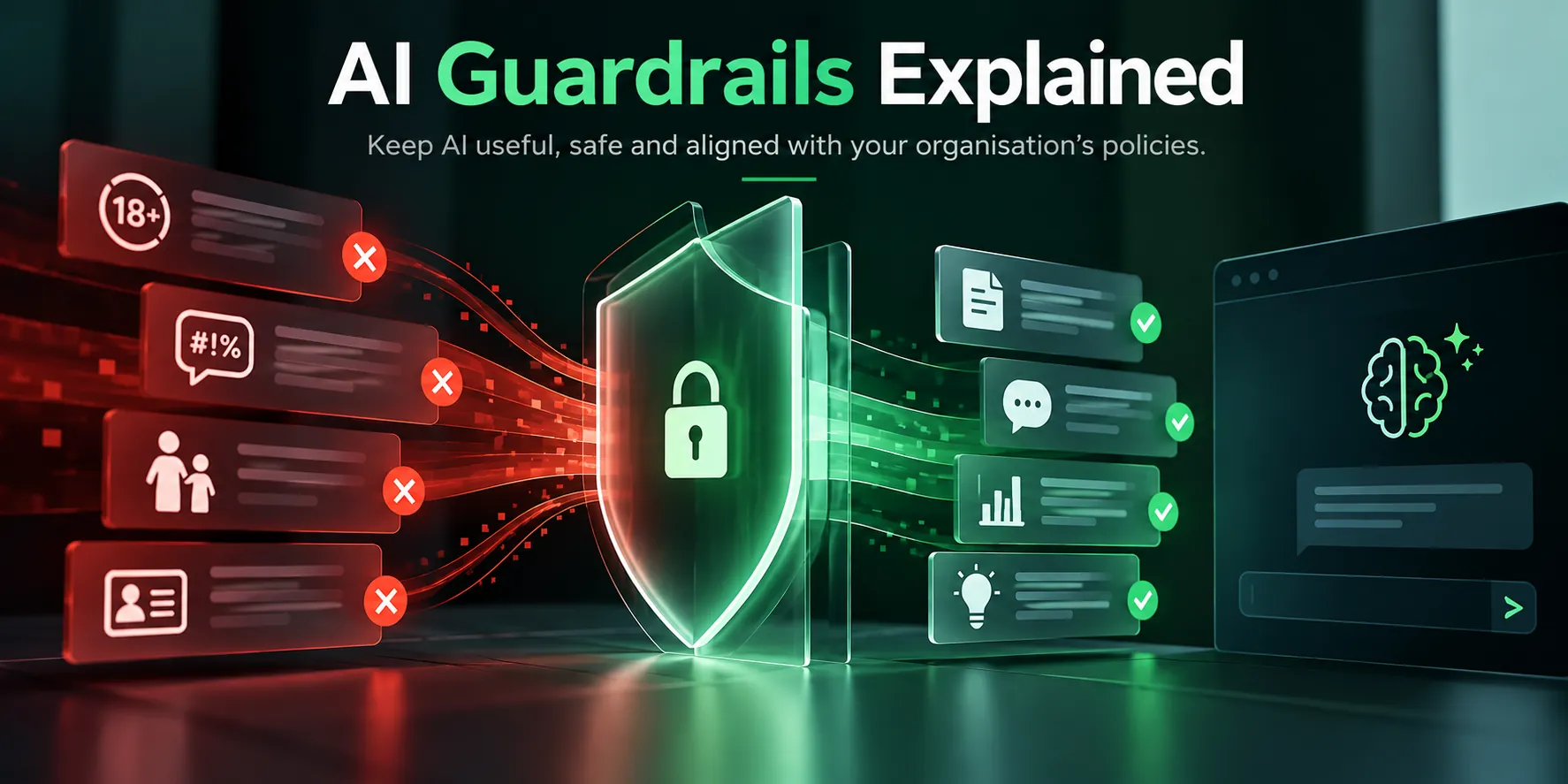
AI guardrails are controls designed to identify, restrict or redirect unwanted content and behaviour. They can cover explicit sexual content (NSFW), toxic or abusive language, personally identifiable information (PII) and child safety.
The industry already provides tools for these purposes. Microsoft offers configurable content-safety filters, while OpenAI provides moderation tools to identify potentially harmful content. However, detecting problematic content is only one part of responsible AI deployment.
When AI goes wrong
These risks are not hypothetical.
In 2023, Bloomberg reported that Samsung restricted employees’ use of generative AI tools after staff reportedly entered sensitive company information into ChatGPT. It demonstrated the difficulty of protecting confidential information when employees use external AI services.
In 2024, Reuters reported that New York City’s MyCity chatbot gave business owners inaccurate guidance about employment rules and other regulations. Incorrect answers can create real consequences when users act on them.
Earlier, Microsoft’s Tay chatbot incident showed how coordinated user abuse could cause a public-facing chatbot to produce offensive content, forcing Microsoft to take it offline.
These incidents illustrate different risks: confidential-data exposure, unreliable answers and deliberate misuse. No single content filter would necessarily prevent all three.
Finding the right balance
Stricter controls are not always better. A customer-facing assistant may require tight restrictions on explicit content and abusive language, while a research team may need to discuss sensitive subjects for legitimate purposes.
Overly restrictive settings can block useful work; overly permissive settings can allow unacceptable responses. Organisations need to determine the appropriate balance for their users, policies and intended applications.
How Infera approaches guardrails
Infera includes built-in guardrails for NSFW content, toxicity, PII and child safety. Enterprise teams can manage sensitivity settings to align these controls with their requirements and risk tolerance.
This provides greater control over how an AI environment behaves, without forcing every organisation to use the same sensitivity level.
Guardrails are not a guarantee of safety. Access permissions, data protection, trusted knowledge sources, output validation and human oversight remain important parts of a broader security strategy. The OWASP guidance on LLM application risks highlights several risks that extend beyond content moderation.
The goal is not to make AI afraid to answer. It is to make AI useful within boundaries that the organisation understands and controls.